
Licensing Requirements in High-Risk Sectors: Vital Insights


Launching a crypto or online gambling startup in Europe or North America means facing regulations that are anything but straightforward. Getting the right licence is not just paperwork, it is your gateway to legal operation and trustworthy credibility. With authorities like the Financial Conduct Authority and complex requirements for anti-money laundering and consumer protection, understanding ex ante regulatory measures can make or break your entry. This guide delivers practical insight to help founders and compliance professionals meet high-risk industry standards with confidence.
Table of Contents
Key Takeaways
Point | Details |
Importance of Licensing | Licensing in high-risk industries is essential for managing risks, ensuring public safety, and maintaining accountability. |
Types of Licences | Different sectors require specific licences, each with unique compliance demands tailored to operational integrity and risk management. |
Global Regulatory Variation | Regulatory frameworks differ significantly across jurisdictions, necessitating a comprehensive compliance strategy that accommodates these variations. |
Consequences of Non-compliance | Non-compliance can lead to severe financial penalties, reputational damage, and operational disruptions, underscoring the need for thorough compliance management. |
Defining licensing in high-risk industries
Licensing in high-risk industries represents a critical regulatory mechanism designed to manage potential risks, protect public safety, and ensure responsible operational practices across sensitive sectors. These industries include domains such as financial technology, online gambling, artificial intelligence, biotechnology, and advanced technological research where potential harm could emerge from inappropriate deployment or misuse.
Specifically, licensing involves government authorities implementing ex ante regulatory measures that require organisations to demonstrate comprehensive compliance before obtaining permission to operate. The process demands companies prove they meet stringent security, ethical, and operational standards. Regulatory control measures focus on preventing potential risks by establishing proactive screening protocols that assess technological capabilities, security frameworks, and potential societal impacts.
The primary objectives of licensing in high-risk sectors include protecting vulnerable populations, preventing technological misuse, maintaining international security standards, and establishing clear accountability mechanisms. For instance, in export-controlled research domains, licensing ensures that advanced technologies or knowledge are not inappropriately transferred or exploited. Export control frameworks specifically target sectors like aeronautical technology, biotechnology, and chemical engineering where potential dual-use applications could pose significant security risks.
Pro tip: When preparing licensing applications for high-risk industries, meticulously document your risk management strategies, technological safeguards, and compliance protocols to demonstrate comprehensive understanding of potential operational challenges.
Major licence types for fintech, crypto, gambling
In the rapidly evolving landscape of high-risk industries, specialised licensing frameworks play a crucial role in regulating financial technologies, cryptocurrency platforms, and gambling services. Financial licensing requirements encompass a diverse range of permits designed to ensure operational integrity, consumer protection, and compliance with stringent regulatory standards.
For fintech enterprises, key licence types include money transmitter licences, payment institution licences, and electronic money licences. Cryptocurrency platforms typically require virtual asset service provider (VASP) licences, which mandate comprehensive anti-money laundering protocols and robust security measures. Gambling operators must obtain specific gaming licences that vary by jurisdiction, often requiring detailed background checks, financial stability assessments, and proven responsible gaming mechanisms.

The complexity of these licensing frameworks reflects the inherent risks in these industries. Regulated professions are subject to rigorous oversight by financial conduct authorities, gaming commissions, and specialised regulatory bodies. Each licence type demands unique compliance criteria, including:
Below is a comparison of major high-risk industry licence types and their core compliance demands.
Licence Type | Main Sector | Core Compliance Focus |
Money Transmitter | Fintech | Transaction security, transparency |
VASP Licence | Cryptocurrency | Anti-money laundering, strong KYC |
Gaming Licence | Online Gambling | Player protection, fair operation |
Payment Institution | Fintech | Capital adequacy, operational resilience |
Electronic Money | Fintech/Crypto | Funds safeguarding, reporting standards |
Comprehensive financial documentation
Proof of operational capability
Robust risk management strategies
Demonstrated commitment to consumer protection
Transparent financial reporting mechanisms
Pro tip: Engage specialised legal counsel with expertise in high-risk sector licensing to navigate the intricate regulatory landscape and ensure complete compliance with jurisdiction-specific requirements.
Global legal frameworks and regulatory authorities
Global legal frameworks for high-risk industries represent complex, multifaceted systems of regulatory oversight that vary significantly across different jurisdictions. Occupational licensing mechanisms serve as critical instruments for ensuring consumer protection, maintaining professional standards, and managing potential risks in sectors such as financial technology, cryptocurrency, and online gambling.
International regulatory authorities typically employ diverse approaches to governance, with each jurisdiction developing unique frameworks tailored to its specific economic and legal context. Regulatory bodies such as the Financial Conduct Authority in the United Kingdom, the Securities and Exchange Commission in the United States, and the European Securities and Markets Authority create comprehensive guidelines that address technological innovation, consumer protection, and market stability. These organisations establish stringent compliance requirements that demand rigorous documentation, financial transparency, and ongoing operational assessments.
The complexity of global legal frameworks is particularly evident in high-risk sectors where technological advancement often outpaces regulatory development. Different regions adopt varied strategies:
The following table highlights how global high-risk industry regulatory models differ.
Region or Approach | Regulatory Model | Key Strength | Main Challenge |
European Union | Centralised, harmonised | Consistent standards | Slow adaptation |
United States | Fragmented, multi-level | Local flexibility | Complex, overlapping oversight |
Asia-Pacific | Diverse, evolving | Rapid innovation | Regulatory unpredictability |
United Kingdom | Principle-based | Focus on risk management | Interpretative ambiguity |
European Union: Centralised regulatory approach with harmonised standards
United States: Fragmented regulatory landscape with state and federal oversight
Asia-Pacific: Rapidly evolving frameworks with significant variation between countries
United Kingdom: Principle-based regulatory model emphasising risk management
Pro tip: Develop a comprehensive compliance strategy that anticipates regulatory variations across multiple jurisdictions, ensuring your organisation can adapt quickly to emerging legal requirements.
Essential compliance, documentation, and due diligence
Compliance in high-risk sectors demands comprehensive and meticulous approaches to documentation, risk management, and regulatory adherence. Licensing documentation processes require organisations to establish robust verification mechanisms that encompass detailed scrutiny of corporate structures, financial frameworks, and operational strategies.
The core components of effective compliance encompass multiple critical domains. Regulatory documentation must comprehensively demonstrate an organisation’s capability to manage potential risks, maintain financial transparency, and adhere to complex legal frameworks. This involves creating extensive documentation sets that include:
Detailed corporate governance policies
Comprehensive risk management protocols
Anti-money laundering (AML) compliance frameworks
Data protection and privacy strategy documents
Financial transaction monitoring systems
Independent audit trail mechanisms
Successful due diligence in high-risk sectors requires a proactive, multifaceted approach that anticipates potential regulatory challenges. Organisations must develop dynamic compliance strategies that can rapidly adapt to evolving legal landscapes, technological innovations, and emerging international regulatory standards. Continuous monitoring, regular internal audits, and maintaining transparent communication with regulatory authorities are fundamental to establishing and maintaining legal credibility.
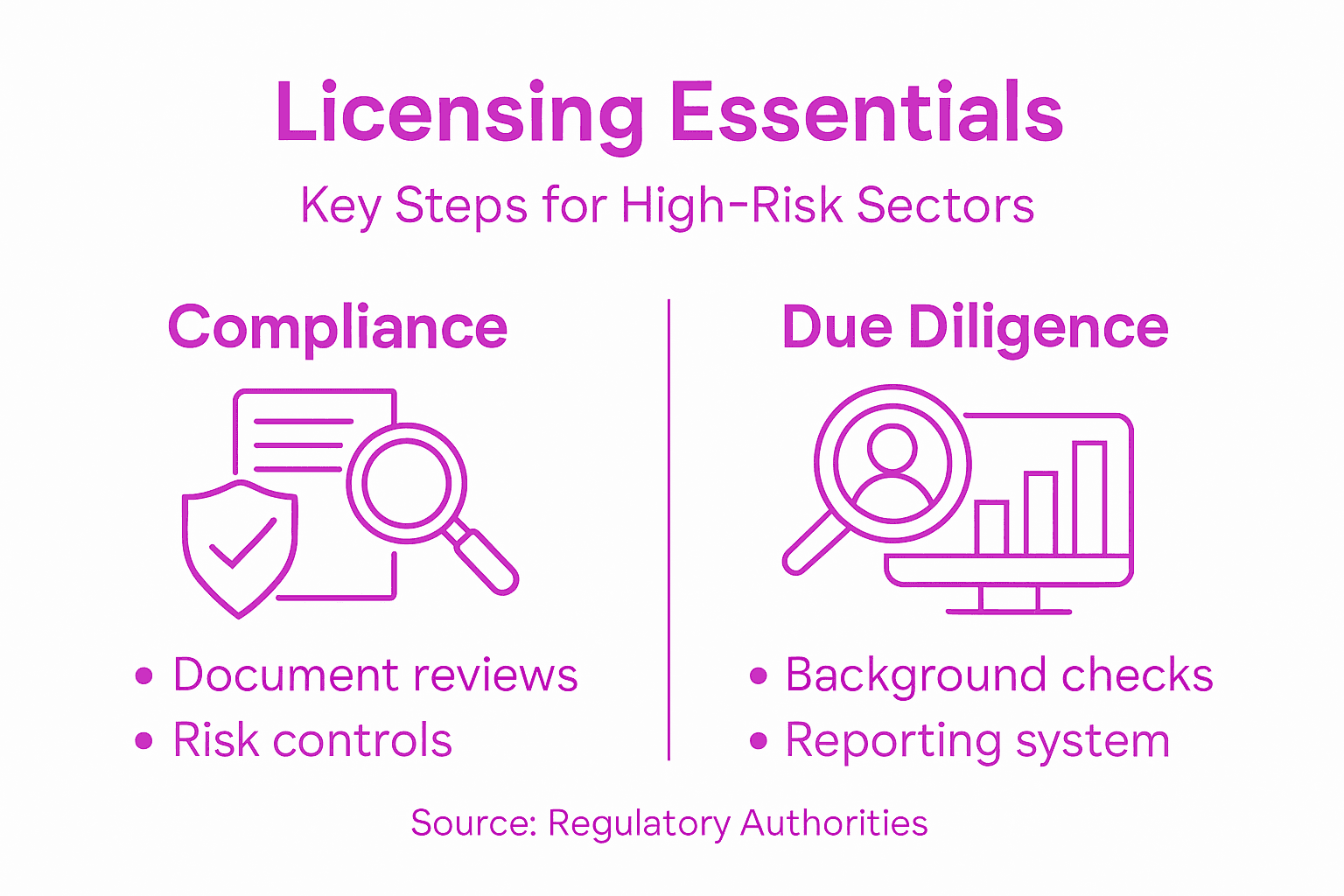
Pro tip: Implement a comprehensive digital compliance management system that centralises documentation, automates reporting processes, and provides real-time regulatory tracking across multiple jurisdictions.
Risks, costs, and liabilities of non-compliance
Non-compliance in high-risk sectors represents a catastrophic operational risk that can fundamentally undermine an organisation’s financial stability and legal standing. Export control violations can trigger severe legal consequences, including substantial financial penalties, potential criminal prosecution, and permanent business licence revocation.
The financial implications of regulatory non-compliance extend far beyond immediate penalties. Organisational risks include increased regulatory scrutiny, dramatically elevated insurance premiums, potential civil litigation, and irreparable reputational damage. Companies may face mandatory operational suspensions, forced restructuring, and substantial legal defence costs that can rapidly deplete financial reserves. Specific financial risks typically encompass:
Punitive regulatory fines
Mandatory compliance remediation expenses
Legal defence and settlement costs
Potential loss of existing business contracts
Permanent industry reputation damage
Increased future compliance monitoring expenses
Professional licensing frameworks demand rigorous adherence to standards that protect public safety and maintain industry integrity. Engineering licensure standards underscore the critical nature of compliance, highlighting that non-adherence can result in negligence claims, safety failures, and potential forced cessation of business activities. The broader societal implications emphasise that licensing requirements are not merely bureaucratic hurdles but essential mechanisms for maintaining professional standards and protecting stakeholder interests.
Pro tip: Invest in comprehensive compliance management systems and allocate dedicated resources for ongoing regulatory training to proactively mitigate potential non-compliance risks.
Navigating common licensing mistakes and pitfalls
Licensing processes in high-risk sectors are fraught with complex challenges that can easily derail an organisation’s regulatory compliance efforts. Licensing mistakes often stem from fundamental misunderstandings of regulatory requirements and insufficient preparation for the intricate documentation processes.
Common pitfalls that organisations frequently encounter include:
Incomplete or inaccurate documentation
Underestimating the time required for licensing
Failing to maintain ongoing compliance mechanisms
Neglecting continued professional education requirements
Insufficient understanding of jurisdiction-specific regulations
Poor communication with regulatory authorities
The most critical licensing errors typically arise from a lack of proactive engagement with regulatory frameworks. Regulatory compliance strategies demand meticulous attention to detail, continuous monitoring of legal changes, and robust internal compliance infrastructure. Many entities mistakenly view licensing as a one-time administrative task, rather than an ongoing strategic process that requires constant vigilance and adaptation.
Pro tip: Develop a dedicated compliance team with specialised knowledge of your specific industry’s regulatory landscape, and implement quarterly internal audits to preemptively identify and address potential licensing vulnerabilities.
Navigate Licensing Complexities in High-Risk Sectors with Expert Legal Support
High-risk industries such as fintech, cryptocurrency, and online gambling face daunting licensing challenges that demand meticulous compliance with global regulatory frameworks and comprehensive risk management. This article highlights critical issues like complex multi-jurisdictional licensing requirements, rigorous due diligence processes, and the costly consequences of non-compliance. If you are aiming to safeguard your organisation, prevent costly penalties, and build a credible reputation, addressing these challenges head-on is essential.
NUR Legal specialises in guiding startups and established businesses through these exact complexities. With deep expertise in obtaining gaming licences in jurisdictions like Curaçao or Anjouan and trusted crypto licence services in Georgia and Seychelles, we help you achieve fast, affordable, and legally compliant business operations. Our professional legal consultancy provides bespoke solutions covering licensing applications, contract reviews, and ongoing compliance strategies so you can stay ahead in rapidly evolving markets.
Take control of your licensing journey before risks escalate. Trust NUR Legal for transparent, efficient, and globally focused legal support tailored to high-risk sectors.
Start your licensing success today with proven experts who understand the stakes. Visit NUR Legal or explore our services for crypto licensing and gaming licence solutions to ensure your business is compliant and well-positioned to thrive.
Frequently Asked Questions
What is the purpose of licensing in high-risk industries?
Licensing in high-risk industries is designed to manage potential risks, protect public safety, and ensure responsible operational practices. It involves regulatory measures that require organisations to demonstrate compliance with stringent standards before being allowed to operate.
What are the major types of licences required for fintech, cryptocurrency, and gambling?
Key licence types include money transmitter licences, payment institution licences, VASP licences for cryptocurrency platforms, and specific gaming licences for gambling operators. Each type has unique compliance requirements focusing on areas such as security, consumer protection, and financial stability.
What are the common challenges in obtaining licensing for high-risk sectors?
Common challenges include incomplete documentation, underestimating the time requirements for processing applications, failing to maintain ongoing compliance, and misunderstanding jurisdiction-specific regulations. These pitfalls can delay or derail obtaining the necessary licences.
What are the risks associated with non-compliance in high-risk industries?
Non-compliance can lead to severe consequences such as hefty financial penalties, operational suspensions, increased regulatory scrutiny, and irreparable reputational damage. It can also result in legal liabilities and substantial costs for compliance remediation and legal defence.
Recommended


Comments