
Role of Legal Counsel: Enabling Compliance in High-Risk Sectors


Every british business working in high-risk sectors faces mounting legal and regulatory pressures. Industries such as fintech and online gambling are seeing ever-more complex rules, and smart legal counsel now acts as much more than just a backstop. Studies show that companies with proactive legal advisors reduce compliance failures by over 40 percent. Understanding the vital role of legal counsel is the key to navigating strict regulatory environments, minimizing risk, and building lasting business confidence.
Table of Contents
Key Takeaways
Point | Details |
Legal Counsel as Strategic Partner | In regulated industries, legal counsel plays a pivotal role in risk management and compliance, transforming legal challenges into business advantages. |
Importance of Technological Competency | Legal professionals must develop both legal and technological skills to navigate evolving regulatory landscapes effectively. |
In-House vs External Counsel | Organisations benefit from a hybrid model that combines the expertise of in-house legal teams with the specialised knowledge of external counsel. |
Proactive Compliance Management | Effective legal counsel takes a proactive stance in anticipating regulatory changes, ensuring ongoing compliance and operational success. |
Defining Legal Counsel in Regulated Industries
Legal counsel represents a pivotal strategic function within high-risk and regulated industries, serving as a critical defence mechanism against potential legal and compliance challenges. These professional advisors operate far beyond traditional legal interpretation, becoming integral partners in corporate risk management and strategic decision-making processes.
In modern regulatory landscapes, legal counsel must navigate increasingly complex frameworks across multiple jurisdictions. Emerging technologies are fundamentally transforming legislative approaches, requiring lawyers to develop sophisticated technological competencies alongside traditional legal expertise. This evolution demands a proactive approach where legal professionals anticipate regulatory shifts rather than merely reacting to them.
The responsibilities of legal counsel in regulated sectors typically encompass several key strategic domains:
Comprehensive risk assessment and mitigation strategies
Regulatory compliance monitoring and implementation
Corporate governance framework development
Crisis management and preemptive legal planning
Technological integration within legal compliance systems
Specifically for high-risk industries such as fintech, crypto, and online gambling, legal counsel becomes an essential guardian of operational legitimacy. Corporate crisis management research highlights their strategic importance in navigating complex legal environments, demonstrating that effective legal counsel can mean the difference between sustainable business operations and potential regulatory shutdown.
Ultimately, legal counsel in regulated industries represents more than a defensive mechanism—they are strategic partners who transform legal complexity into competitive advantage, enabling businesses to operate confidently within challenging regulatory landscapes.
Types of Legal Counsel: In-House vs. External
In the complex landscape of regulated industries, organisations have two primary approaches to legal support: in-house legal counsel and external legal counsel. Each model offers distinct advantages and challenges, requiring strategic decision-making based on the organisation’s specific operational needs, budget, and regulatory complexity.
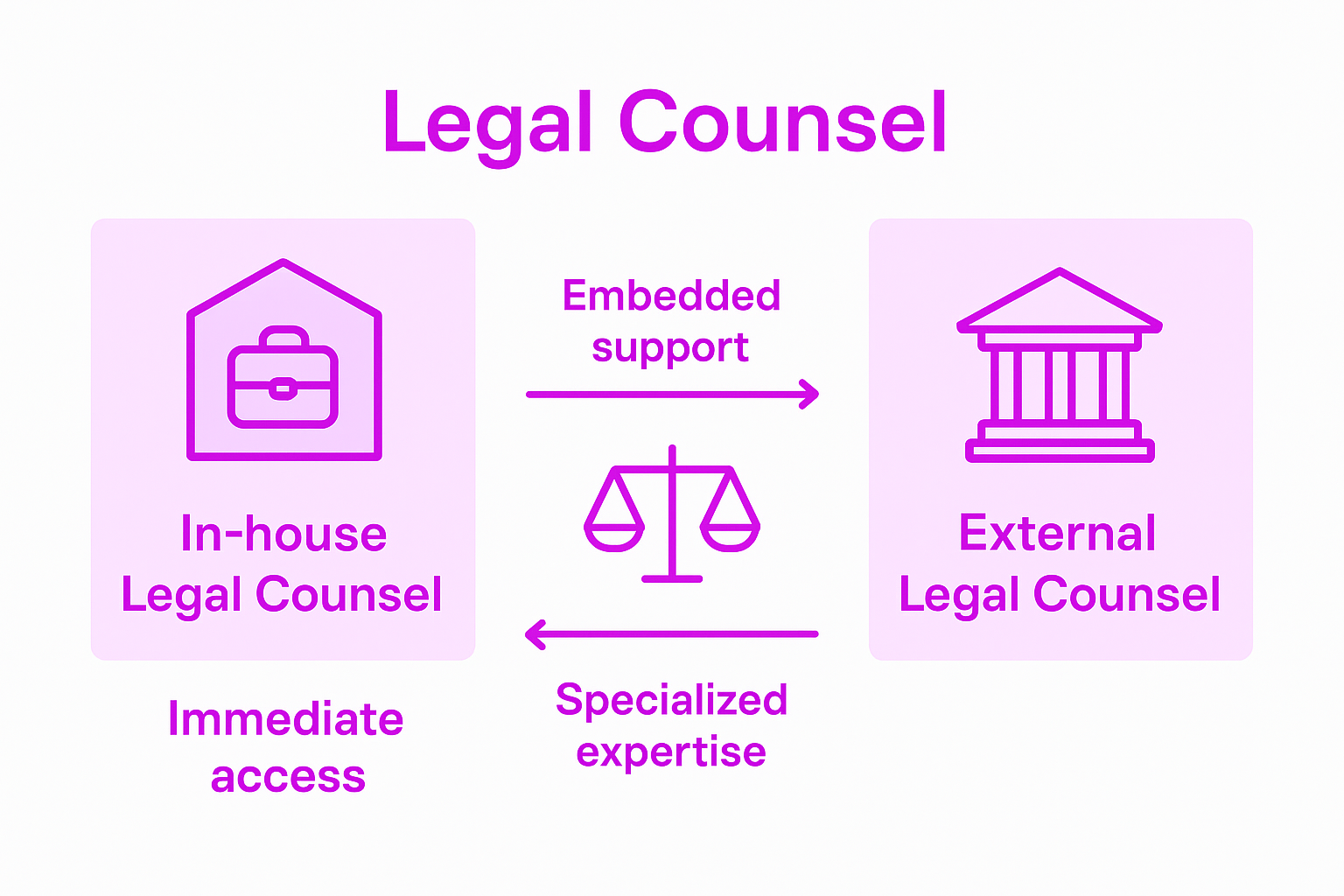
Changing recruitment practices and career dynamics reveal significant shifts in legal service delivery, with companies increasingly re-evaluating their legal resource strategies. In-house legal teams provide immediate, specialised expertise directly embedded within corporate structures, offering nuanced understanding of the organisation’s unique operational context.
Key distinctions between in-house and external legal counsel include:
Cost structure and billing models
Depth of organisational knowledge
Responsiveness and accessibility
Specialisation and breadth of expertise
Conflict management capabilities
Research on corporate legal functions highlights the evolving role of in-house solicitors, demonstrating a trend towards more integrated and strategically positioned legal departments. External counsel, meanwhile, brings comprehensive cross-industry perspectives and specialised expertise that can be particularly valuable in complex regulatory environments.
Ultimately, high-risk industries require a nuanced approach, often leveraging a hybrid model that combines the strategic depth of in-house counsel with the specialised knowledge of external legal experts. This balanced strategy allows businesses to maintain robust legal protection while remaining adaptable to rapidly changing regulatory landscapes.
Key Responsibilities in Licencing and Compliance
Legal counsel in high-risk sectors play a critical role in navigating complex regulatory environments, with licensing and compliance representing the cornerstone of their professional responsibilities. These professionals must systematically manage intricate legal frameworks that govern operations across multiple jurisdictional boundaries, ensuring organisational integrity and regulatory adherence.

The primary responsibilities encompass several strategic domains, including comprehensive risk assessment, regulatory monitoring, and proactive compliance management. Regulatory insights are continuously documented in our industry articles, demonstrating the dynamic nature of legal compliance in challenging business landscapes.
Key compliance responsibilities include:
Comprehensive regulatory framework analysis
Risk identification and mitigation strategies
Licence application and renewal processes
Ongoing regulatory monitoring and reporting
Development of internal compliance protocols
Engagement with regulatory authorities
Documentation and record-keeping management
Specifically for high-risk industries like fintech, gambling, and cryptocurrency, legal counsel must develop sophisticated mechanisms to anticipate and address potential regulatory challenges. This involves not just reactive compliance, but proactive strategy development that positions organisations to adapt swiftly to emerging regulatory requirements.
Successful legal counsel in licensing and compliance functions as a strategic partner, transforming complex regulatory challenges into sustainable operational frameworks. Their expertise enables businesses to navigate intricate legal landscapes while maintaining robust governance structures that protect both organisational interests and stakeholder investments.
Legal Counsel’s Role in Cross-Border Operations
Cross-border operations represent a complex legal landscape where legal counsel must navigate intricate international regulatory environments, balancing multiple jurisdictional requirements with strategic business objectives. These professionals serve as critical architects of legal strategy, ensuring organisations can operate effectively across diverse regulatory frameworks while maintaining comprehensive legal compliance.
Regulatory insights within our industry articles demonstrate the multifaceted challenges inherent in international legal navigation. Legal counsel must develop sophisticated mechanisms to reconcile divergent legal systems, understanding nuanced differences in regulatory approaches, corporate governance standards, and compliance expectations.
Key responsibilities in cross-border legal operations include:
Comprehensive international regulatory mapping
Jurisdictional risk assessment
Compliance strategy development
Contractual framework harmonisation
Cross-border transaction legal structuring
Multinational corporate governance alignment
International dispute resolution preparation
In high-risk sectors such as financial technology, cryptocurrency, and online gambling, legal counsel must anticipate potential regulatory conflicts and proactively develop strategies that enable seamless operational continuity. This requires deep understanding of international legal principles, emerging regulatory trends, and the ability to interpret complex legal frameworks across different cultural and legal contexts.
Ultimately, legal counsel in cross-border operations function as strategic translators—converting complex international legal requirements into actionable business strategies. Their expertise enables organisations to expand globally while maintaining robust legal protection, transforming potential regulatory challenges into opportunities for sustainable international growth.
Mitigating Risks and Avoiding Compliance Failures
Risk mitigation represents a critical strategic imperative for legal counsel operating in high-stakes regulatory environments. Organisations must develop comprehensive frameworks that proactively identify, assess, and neutralise potential compliance vulnerabilities before they escalate into significant legal challenges.
Advanced legal intelligence systems are increasingly leveraging artificial intelligence to enhance risk management capabilities, transforming traditional reactive approaches into sophisticated predictive strategies. These technological innovations enable legal counsel to conduct more nuanced and comprehensive risk assessments, identifying potential regulatory breaches with unprecedented precision and efficiency.
Effective risk mitigation strategies typically encompass several key dimensions:
Comprehensive regulatory mapping
Continuous monitoring of legal landscape changes
Proactive compliance protocol development
Regular internal audit mechanisms
Staff training and awareness programmes
Rapid response and remediation planning
Technology-enabled risk detection systems
Comparative analyses between traditional and AI-powered contract review methodologies demonstrate significant potential for improving legal risk management accuracy. By integrating advanced technological tools, legal counsel can dramatically reduce human error and enhance the speed and comprehensiveness of compliance verification processes.
Successful risk mitigation is not merely about avoiding penalties, but about creating a robust organisational culture that views regulatory compliance as a strategic advantage. Legal counsel must transform compliance from a bureaucratic requirement into a dynamic, adaptive framework that supports sustainable business growth while maintaining the highest standards of legal and ethical integrity.
Empower Your Compliance Strategy with Expert Legal Counsel
Navigating the complex regulatory challenges in high-risk sectors like fintech, crypto, and gambling requires more than just understanding the law. The article highlights the critical importance of proactive legal counsel in risk mitigation, licensing, and cross-border compliance. If you are striving to transform legal complexities into a sustainable competitive advantage, addressing pain points such as licensing delays, compliance failures, and jurisdictional inconsistencies, comprehensive support tailored to your unique needs is essential.
At NUR Legal, we specialise in enabling businesses to operate confidently in highly regulated markets by providing fast, affordable licensing services and robust compliance frameworks. Whether you seek a trusted partner for securing your crypto licence in Georgia or Seychelles, or require expert guidance through the full gaming licensing processes in Curaçao or Anjouan, our dedicated team delivers transparent, professional solutions designed to meet the evolving demands identified in the article. Take control of your legal compliance now and turn regulatory challenges into growth opportunities.
Explore our comprehensive services on NUR Legal’s main site and discover how partnering with specialised legal counsel provides the strategic edge you need to succeed.
Frequently Asked Questions
What is the role of legal counsel in high-risk industries?
Legal counsel in high-risk industries serves as a strategic partner, providing expertise in regulatory compliance, risk assessment, and crisis management to navigate complex legal environments.
How do in-house and external legal counsel differ in their functions?
In-house legal counsel is embedded within an organisation, offering immediate and specialised knowledge, while external legal counsel brings broader expertise from various industries, often addressing complex regulatory issues.
What are the key responsibilities of legal counsel regarding licensing and compliance?
Legal counsel is responsible for regulatory framework analysis, risk identification, licence applications, ongoing monitoring, and developing internal compliance protocols to ensure regulatory adherence in high-risk sectors.
How can organisations mitigate risks in high-risk regulatory environments?
Organisations can mitigate risks by developing comprehensive compliance frameworks, conducting continuous legal monitoring, implementing proactive strategies, and leveraging technology for enhanced risk detection.
Recommended


Comments