
Legal Opinion Process for Startups: A Complete Execution Guide


Securing a license in high-risk fintech and crypto fields often hinges on interpreting British regulatory standards alongside other local laws. The smallest oversight can cost startups real opportunities, especially since more than 35 percent of legal opinion submissions in these sectors face delays due to incomplete documentation. Founders and compliance officers aiming for global expansion need practical strategies that demystify cross-border requirements and highlight clear steps for assembling compliant legal opinions.
Table of Contents
Quick Summary
Essential Insight | Explanation |
1. Assess Jurisdictional Licensing Needs | Research licensing requirements in target jurisdictions to ensure compliance and mitigate risks. |
2. Compile Thorough Documentation | Gather all critical documents to validate your startup’s credibility and readiness for licensing. |
3. Engage Experienced Legal Experts | Consult with legal professionals for tailored opinions on regulatory compliance and industry nuances. |
4. Develop Proactive Compliance Strategies | Implement systematic monitoring to address evolving regulatory developments and minimise legal risks. |
5. Validate Legal Opinions Thoroughly | Conduct exhaustive checks on legal opinions before submission to ensure accuracy and compliance with regulations. |
Step 1: Assess licensing requirements and jurisdiction
Navigating the legal landscape for startup licensing demands a strategic approach that balances regulatory compliance with business objectives. Understanding jurisdictional nuances is crucial when determining intellectual property rights transfer mechanisms52/en/pdf) across international boundaries.
Startups must conduct comprehensive research into target jurisdictions to identify specific licensing prerequisites. This process involves examining multiple critical dimensions including regulatory frameworks, competition laws, territorial restrictions, and potential intellectual property constraints. You will need to evaluate not just the general legal environment but also sector specific requirements that might impact your specific business model. Pay particular attention to how different jurisdictions interpret licensing agreements and the potential variations in enforcement mechanisms.
Careful documentation becomes paramount during this assessment phase. Create a detailed matrix mapping jurisdictional requirements against your startup’s specific operational needs. This systematic approach helps identify potential legal challenges before they emerge and provides a clear roadmap for compliance strategies.
Top Tip: Engage local legal expertise in each target jurisdiction to gain nuanced insights that generic research might overlook.
Step 2: Compile necessary documentation and business details
Preparing a comprehensive documentation package is essential for establishing legal credibility and facilitating smooth licensing processes for your startup. Your goal is to create a robust dossier that demonstrates your business’s legitimacy and compliance potential.

The documentation compilation requires meticulous attention to detail. You will need to gather a range of critical documents that systematically validate your startup’s operational framework. This includes incorporation papers, financial statements, intellectual property registrations, partnership agreements, and regulatory compliance certifications. Each document serves as a critical piece of evidence demonstrating your business’s structural integrity and legal preparedness. Ensure that all documentation is current, accurately translated if necessary, and organised in a logical manner that allows for easy verification.
Beyond standard documentation, pay special attention to gathering evidence of beneficial ownership, detailed business structure information, and comprehensive client identification records. These elements are crucial for establishing transparency and mitigating potential risks associated with financial irregularities. Carefully cross reference your documentation against jurisdictional requirements to ensure complete alignment with local regulatory expectations.
Here’s a summary of essential documentation types and their business importance for startup licensing:
Document Type | Purpose | Business Impact |
Incorporation Papers | Establish legal existence | Enables business operations |
Financial Statements | Demonstrate financial credibility | Facilitates regulatory trust |
IP Registrations | Prove ownership of intellectual property | Protects innovation and branding |
Partnership Agreements | Outline collaborative relationships | Clarifies stakeholder roles |
Compliance Certifications | Show adherence to laws and regulations | Eases approval by authorities |
Beneficial Ownership Evidence | Identify true controlling interests | Reduces risks of hidden ownership |
Client Identification Records | Verify customer identities | Supports transparency and KYC |
Top Tip: Create a digital and physical backup of all documentation and maintain a comprehensive index to streamline future compliance processes.
Step 3: Engage legal experts for drafting opinions
Securing a comprehensive legal opinion requires strategic engagement with experienced legal professionals who can provide nuanced insights into your startup’s regulatory landscape. Your primary objective is to obtain a detailed assessment that validates your business operations across complex legal frameworks.
The process of engaging legal experts demands careful selection and clear communication. You will need to identify legal professionals specialising in researching and drafting authoritative legal memoranda that address your specific jurisdictional challenges. Seek counsel with demonstrable expertise in your industry sector who can provide a comprehensive analysis citing relevant statutes, case precedents, and legal principles. During initial consultations, prepare a detailed brief outlining your business model, target jurisdictions, and specific legal uncertainties requiring clarification. This enables legal experts to conduct targeted research and develop a precise, tailored legal opinion addressing your unique operational context.
Professional legal opinions require extensive collaboration and iterative refinement. Expect multiple drafting stages where your legal counsel will develop a comprehensive document evaluating potential legal risks, compliance requirements, and strategic recommendations. Be prepared to provide additional context, answer detailed queries, and review draft opinions meticulously. The final document should offer clear, actionable insights that support your startup’s strategic decision making and regulatory compliance.
Top Tip: Request sample legal opinions from potential legal experts to assess their depth of analysis and communication style before finalising engagement.
Step 4: Review and address regulatory concerns
Navigating the complex landscape of regulatory compliance requires a systematic and proactive approach for startups seeking to establish legal credibility. Your objective is to develop a comprehensive understanding of applicable regulations and create robust strategies for addressing potential compliance challenges.
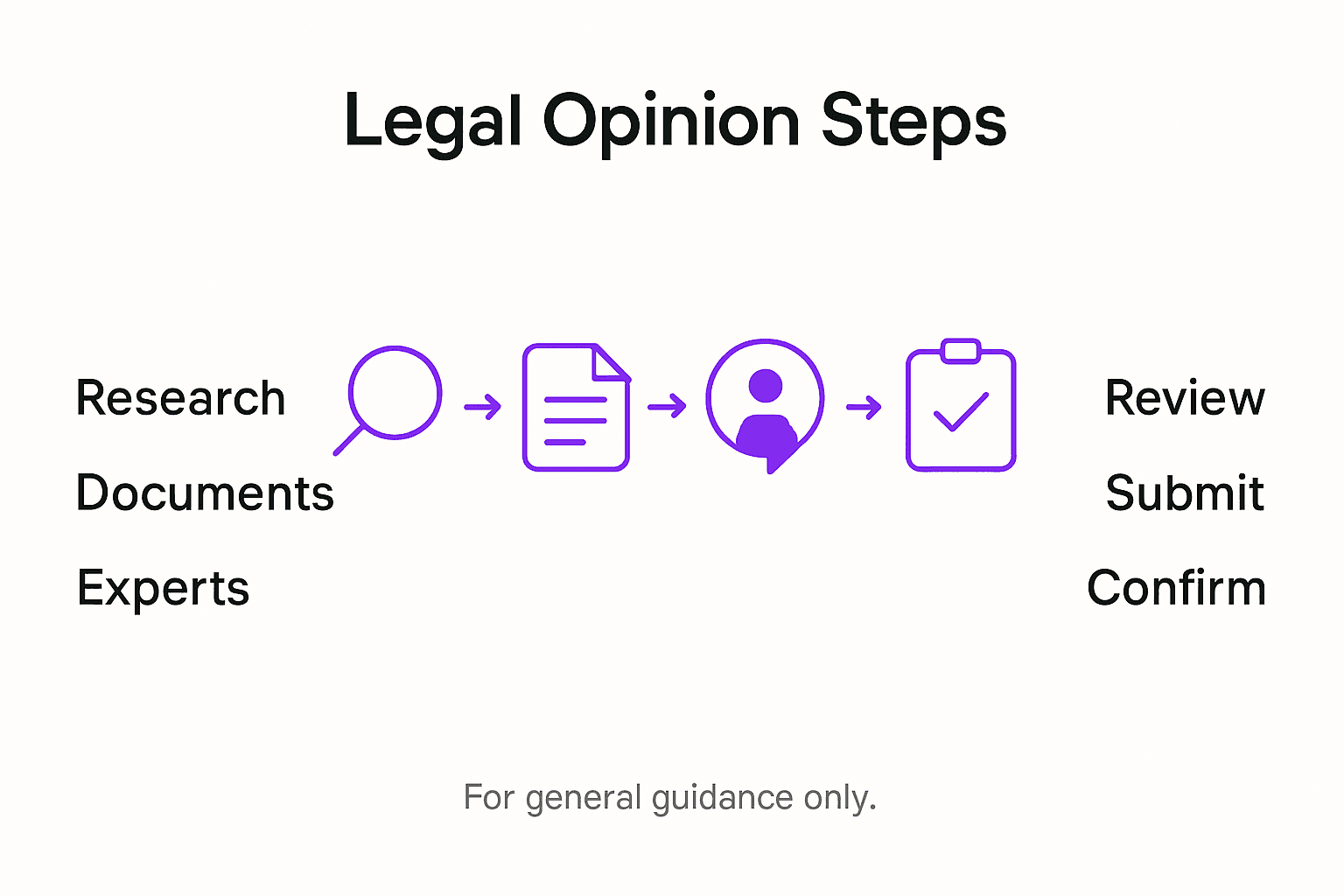
The review process begins with comprehensive research into evolving regulatory developments affecting your specific business sector. You must meticulously analyse statutes, guidelines, and legal frameworks relevant to your operational jurisdiction. This involves monitoring regulatory updates, understanding administrative requirements, and identifying potential areas of legal vulnerability. Pay close attention to sector specific regulations such as data privacy standards, financial reporting requirements, and industry specific compliance metrics. Create a detailed regulatory mapping that catalogues all applicable legal obligations and potential compliance risks associated with your business model.
Addressing regulatory concerns demands a proactive and strategic approach. Develop a dynamic compliance framework that allows for continuous monitoring and adaptation to changing regulatory landscapes. Implement internal control mechanisms that enable rapid response to emerging regulatory requirements. This might involve establishing dedicated compliance teams, investing in regular training programmes, and developing robust documentation processes that demonstrate your commitment to meeting legal standards. Your goal is to transform regulatory compliance from a potential burden into a strategic advantage that builds trust with stakeholders and regulators.
This table contrasts proactive and reactive compliance approaches for startups:
Approach | Key Characteristics | Typical Results | Long-Term Value |
Proactive | Anticipates regulatory changes | Minimises legal surprises | Builds stakeholder trust |
Reactive | Responds after issues arise | Risk of penalties | May erode credibility |
Top Tip: Invest in regulatory intelligence tools and subscribe to authoritative legal updates to stay ahead of potential compliance challenges.
Step 5: Validate and submit legal opinions for approval
Successfully navigating the legal opinion submission process requires meticulous preparation and strategic validation to ensure comprehensive regulatory compliance. Your objective is to transform your carefully drafted legal opinion into an authoritative document that withstands rigorous professional scrutiny.
The validation stage involves systematic risk assessment and verification of critical documentation parameters. Conduct an exhaustive internal review that examines each aspect of the legal opinion for accuracy, comprehensiveness, and alignment with regulatory standards. This process requires careful verification of client identity details, thorough assessment of beneficial ownership documentation, and cross reference of all statutory requirements. Pay particular attention to potential conflicts of interest, ensuring that your legal opinion demonstrates impartiality and adheres to procedural safeguards mandated by relevant regulatory frameworks.
Submission of legal opinions demands a structured and professional approach. Prepare a comprehensive cover letter that contextualises your legal opinion, highlighting key findings and demonstrating the methodological rigour of your research. Anticipate potential queries by including supplementary documentation that substantiates your conclusions. Be prepared for potential requests for additional information or clarification from regulatory bodies. Your submission should reflect a proactive compliance mindset that goes beyond mere procedural requirements and demonstrates your commitment to maintaining the highest standards of legal and regulatory integrity.
Top Tip: Develop a standardised internal checklist for legal opinion validation to ensure consistent and thorough review across all submissions.
Navigate the Legal Opinion Process with Confidence and Expert Support
Startups face complex challenges when preparing detailed legal opinions and navigating evolving regulatory requirements as outlined in our guide Legal Opinion Process for Startups: A Complete Execution Guide. The pressure to fully assess jurisdictional licensing needs while producing comprehensive documentation can feel overwhelming. Startups must also engage experienced legal counsel and validate submissions meticulously to avoid costly delays or compliance risks.
At NUR Legal, we specialise in turning these demanding tasks into streamlined solutions tailored for high-risk and regulated industries such as fintech, crypto, and gambling. We provide expert legal opinions, licensing support, and company formation services across multiple jurisdictions to help your startup secure crucial approvals with confidence. Our established relationships with regulators and deep compliance expertise ensure your legal opinion process is managed efficiently and transparently.
Take the next step to secure your startup’s future by partnering with specialists who understand the complexities of your sector. Visit NUR Legal for trusted guidance on licensing and compliance.
Empower your startup today with professional legal consultancy and licensing solutions. Contact NUR Legal now to receive personalised assistance and accelerate your legal opinion process with certainty and care. Explore our comprehensive services at NUR Legal and discover how we can facilitate your business growth in challenging markets.
Frequently Asked Questions
What are the initial steps to assess licensing requirements for my startup?
To assess licensing requirements, begin by researching the specific regulations and licensing prerequisites in your target jurisdictions. Focus on understanding local competition laws and any sector-specific requirements that may affect your business model.
How can I compile the necessary documentation for a legal opinion?
Gather critical documents such as incorporation papers, financial statements, and compliance certifications to establish your startup’s legitimacy. Organise these documents in a logical manner to facilitate easy verification and ensure they are current and accurately translated if needed.
What should I look for when engaging legal experts for drafting a legal opinion?
When engaging legal experts, seek professionals with experience in your industry who can provide tailored assessments based on your specific jurisdictional challenges. Prepare a detailed brief outlining your business model and legal uncertainties to enable them to conduct focused research and provide actionable insights.
How do I effectively address regulatory concerns during the legal opinion process?
To address regulatory concerns, conduct comprehensive research into relevant regulations affecting your business sector and develop a dynamic compliance framework. Implement internal controls and invest in regular training programmes to ensure your startup can adapt to evolving regulatory requirements.
What validation steps should I take before submitting a legal opinion for approval?
Before submitting a legal opinion, perform a thorough internal review to verify the accuracy and completeness of your documentation. Prepare a professional cover letter that highlights key findings, and be ready to furnish additional information if requested by regulatory bodies to enhance the robustness of your submission.
Recommended


Comments