
Legal Challenges in Fintech—Navigating Global Compliance


Every british fintech founder faces an uphill battle against complex legal barriers. The belief that financial regulations are universal quickly falls apart once you encounter the sharp differences between American, European, and Asian frameworks. More than 85 percent of global fintech leaders struggle with at least one major jurisdictional compliance issue every year. This article shines a light on common misconceptions and helps you avoid costly mistakes as you seek licensing for high-risk operations worldwide.
Table of Contents
Key Takeaways
Point | Details |
Regulatory Variability | Fintech companies face diverse regulatory frameworks across jurisdictions, requiring tailored compliance strategies. |
Licensing Complexity | Organisations must understand unique licensing requirements in each region to operate successfully. |
Operational Risks | Cybersecurity threats and regulatory non-compliance are significant risks that must be proactively managed. |
Integrated Compliance Strategies | An adaptive compliance intelligence system is essential for navigating the dynamic regulatory landscape and ensuring organisational resilience. |
Fintech legal landscape and misconceptions
The global fintech landscape represents a complex terrain of innovation, regulation, and persistent legal challenges that often confound entrepreneurs and financial professionals. Despite widespread assumptions about digital finance, the regulatory environment remains fragmented and nuanced. Global fintech developments reveal significant asymmetries between innovative financial technologies and existing compliance frameworks, creating substantial legal uncertainties.
Common misconceptions about fintech regulation proliferate, with many stakeholders believing that digital financial services operate under uniform global standards. In reality, regulatory approaches vary dramatically across jurisdictions. Some nations embrace technological innovation with flexible frameworks, while others maintain stringent control mechanisms. Regulatory divergence means fintech companies must navigate intricate legal landscapes that differ substantially between countries, requiring sophisticated legal expertise and localised compliance strategies.
The academic research highlights critical risks emerging from this complex environment. Comprehensive academic reviews have mapped the global fintech ecosystem, revealing that innovations are not inherently low-risk or universally beneficial. Cybersecurity threats, data protection challenges, and potential financial fraud represent significant concerns that regulatory bodies are still struggling to address comprehensively. Financial technology firms must therefore adopt proactive risk management approaches that anticipate and mitigate potential legal vulnerabilities.
Pro tip: Develop a multijurisdictional compliance strategy that considers regional regulatory nuances and maintains flexibility for rapid legal adaptation.
To clarify how regulatory approaches differ across the globe, see this comparison:
Region | Regulatory Approach | Impact on Fintech Firms |
European Union | Harmonised, risk-based | Streamlined passports but varied detail |
United States | Fragmented, state-led | Multiple licences, high complexity |
Asia-Pacific | Mixed, innovation-driven | Fast innovation, evolving requirements |
Africa | Diverse, emerging policies | Unpredictable, informal regulation common |
Licensing requirements across jurisdictions
Licensing for fintech companies represents a critically complex challenge, with regulations varying dramatically across global jurisdictions. Comprehensive international research reveals significant disparities in regulatory approaches for digital financial services, creating substantial complexity for organisations seeking multinational operational permissions. These variations mean that a licensing strategy effective in one jurisdiction may prove entirely inadequate in another.

The global landscape demonstrates profound differences in licensing frameworks. While some regions like the European Union pursue regulatory harmonisation, most countries maintain unique licensing models with distinctive threshold criteria. These jurisdictional nuances impact critical aspects such as capital requirements, compliance obligations, and operational permissions. The International Bar Association’s global report highlights that out of 39 jurisdictions studied, nearly every region maintains distinctly different approaches to fintech regulation.
Key licensing considerations typically encompass multiple domains, including payments, lending, insurance, and emerging digital financial services. Organisations must prepare comprehensive documentation demonstrating robust governance structures, technological capabilities, financial stability, and comprehensive risk management protocols. This requires detailed understanding of local regulatory expectations, which often extend beyond standard financial compliance into technology, cybersecurity, and consumer protection domains.
Pro tip: Engage local legal experts in each target jurisdiction to develop a granular, jurisdiction-specific licensing strategy that anticipates potential regulatory challenges.
Cross-border compliance and regulatory barriers
Complex legal challenges in cross-border fintech operations reveal profound regulatory fragmentation that substantially impedes global financial innovation. The contemporary digital finance landscape is characterised by significant legal uncertainties arising from divergent national approaches to technology regulation, data protection, and financial compliance. These disparities create substantial operational barriers for fintech enterprises seeking to expand across international boundaries.
The governance challenges extend beyond mere administrative complexities. Emerging research highlights critical gaps in regulatory frameworks, particularly in areas such as anti-money laundering (AML), digital identity verification, and cybersecurity standards. Global studies exploring cross-border fintech governance demonstrate persistent challenges in harmonising regulatory approaches, with each jurisdiction maintaining distinct interpretations of financial technology regulations.
Fintech organisations must therefore develop sophisticated, adaptive compliance strategies that can navigate these complex regulatory landscapes. This requires comprehensive understanding of local legal requirements, proactive risk management, and continuous monitoring of regulatory developments. Successful cross-border operations demand not just technical capability, but intricate legal expertise that can interpret and implement compliance measures across multiple jurisdictional contexts.
Pro tip: Develop a centralised compliance intelligence function that continuously tracks regulatory changes and maintains flexible, jurisdiction-specific operational protocols.
Data protection, cybersecurity, and operational risks
Systematic reviews of cyber threats in the global fintech sector reveal a complex landscape of evolving digital vulnerabilities that challenge traditional security paradigms. Modern financial technology organisations face unprecedented risks that extend far beyond conventional financial protection mechanisms. These challenges encompass sophisticated cybercriminal tactics, intricate data protection requirements, and rapidly changing technological ecosystems that demand continuous adaptive security strategies.
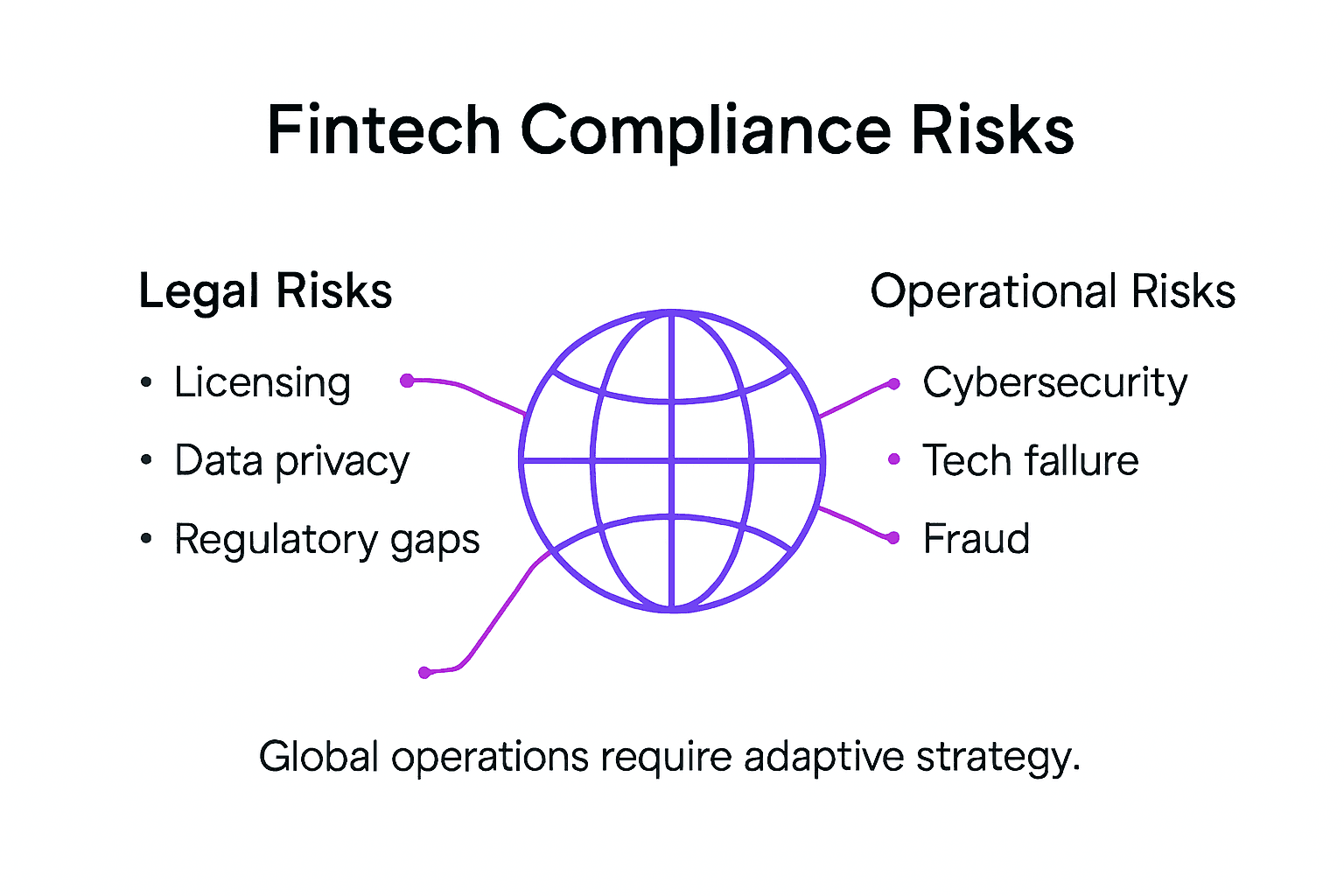
The regulatory landscape surrounding data protection has become increasingly complex, with global frameworks like the General Data Protection Regulation (GDPR) imposing stringent requirements on how organisations handle sensitive information. Contemporary research exploring regulatory and technical cybersecurity challenges demonstrates that fintech enterprises must balance innovative technological development with robust protection mechanisms. This involves implementing comprehensive risk management protocols, advanced encryption technologies, and sophisticated threat detection systems that can respond dynamically to emerging digital risks.
Operational risks in fintech extend beyond immediate technological vulnerabilities, encompassing broader strategic challenges related to data governance, regulatory compliance, and organisational resilience. Financial technology companies must develop holistic approaches that integrate cybersecurity considerations into every layer of their operational strategy. This requires not just technological solutions, but also cultural transformations that prioritise security awareness, continuous learning, and proactive risk management across all organisational levels.
Pro tip: Implement a comprehensive, multi-layered cybersecurity framework that integrates technological solutions, ongoing staff training, and adaptive risk management protocols.
The following table summarises major operational risks unique to fintech:
Operational Risk Area | Description | Example Consequence |
Cybersecurity Threats | Attacks targeting digital financial systems | Customer data breach |
Regulatory Non-compliance | Failure to meet legal obligations | Heavy fines or restrictions |
Data Management Gaps | Weak management of sensitive client data | Reputational and legal harm |
Technology Reliability | System failures impacting operations | Service outage or loss |
Risk management and common compliance pitfalls
Comprehensive risk management frameworks in fintech reveal a complex landscape of regulatory challenges that demand sophisticated, multi-dimensional approaches. Financial technology organisations frequently encounter intricate compliance obstacles that extend far beyond traditional regulatory expectations. These challenges encompass not just legal adherence, but strategic risk mitigation that requires deep understanding of technological, operational, and regulatory intersections.
The most prevalent compliance pitfalls emerge from inadequate understanding of sector-specific regulatory requirements. Detailed industry research highlights systematic failures in fintech regulatory implementation that often stem from fragmented approaches to anti-money laundering protocols, insufficient licensing strategies, and weak data protection mechanisms. Organisations routinely underestimate the complexity of building comprehensive compliance infrastructures that can adapt to rapidly evolving technological and regulatory landscapes.
Successful risk management in fintech demands a holistic approach that integrates technological capabilities, legal expertise, and proactive governance strategies. This requires developing robust internal frameworks that continuously monitor regulatory shifts, assess potential vulnerabilities, and implement adaptive compliance mechanisms. Financial technology enterprises must cultivate a culture of regulatory awareness that views compliance not as a static requirement, but as a dynamic, strategic imperative that underpins sustainable innovation and organisational resilience.
Pro tip: Develop an integrated compliance intelligence system that combines automated regulatory tracking, periodic risk assessments, and cross-functional organisational training.
Overcome Legal Challenges in Fintech with Expert Guidance
Navigating the complex global compliance landscape outlined in this article can feel overwhelming. From multijurisdictional licensing hurdles to the intricate demands of data protection and cybersecurity, fintech companies often face regulatory fragmentation and operational risks that threaten their growth and stability. Understanding these challenges is the first step—partnering with experts who specialise in these areas is the key to unlocking success.
At NUR Legal, we specialise in providing tailored legal support for fintech ventures dealing with high-risk and regulated markets worldwide. Our services include securing licences across critical jurisdictions such as Curaçao, Anjouan, Georgia, and Seychelles, combined with comprehensive compliance advisory and company formation solutions. Act now to build a robust, legally compliant foundation that adapts swiftly to evolving regulatory demands. Explore how our expertise can simplify your licensing process and compliance strategy by visiting NUR Legal Services. Take control of your fintech future with trusted legal partners by your side.
Frequently Asked Questions
What are the common misconceptions about fintech regulation?
Many stakeholders wrongly believe that financial technology operates under uniform global standards. In reality, regulatory approaches vary widely across jurisdictions, creating legal uncertainties due to differing compliance frameworks.
What factors should fintech companies consider for licensing in different jurisdictions?
Fintech companies must understand unique licensing models, including capital requirements, compliance obligations, and operational permissions that vary by region. Engaging local legal experts can help develop effective strategies tailored to specific regulatory expectations.
What are the key operational risks faced by fintech companies?
Key operational risks include cybersecurity threats, regulatory non-compliance, data management gaps, and technology reliability issues. Organisations must adopt multi-layered risk management strategies to mitigate these challenges effectively.
How can fintech firms manage cross-border compliance challenges?
Fintech firms need to develop sophisticated compliance strategies that navigate divergent national regulations regarding technology, data protection, and financial compliance. Continuous monitoring of regulatory changes and engaging legal expertise are vital for successful international operations.
Recommended


Comments