
Role of Legal Consultancy: Enabling Safe Market Entry


Most British fintech founders aiming for cross-border growth face stricter hurdles in international licensing, especially when tackling volatile markets such as the European Union. Regulatory complexity and fast-moving compliance standards mean a single misstep can cost thousands in fines or stall entry plans. This overview demystifies legal consultancy for high-risk sectors, showing how tailored strategies can shield your organisation from major risks while targeting compliance perfect for crypto and financial startups.
Table of Contents
Key Takeaways
Point | Details |
Role of Legal Consultancy | Legal consultancy provides strategic support for organisations in high-risk sectors, helping them navigate complex regulatory environments and mitigate legal vulnerabilities. |
Core Services | Essential services include licensing and compliance support, enabling organisations to establish legal operational frameworks across various jurisdictions. |
Specialisations | Specialisations in legal consultancy vary, addressing specific industry challenges such as corporate law, regulatory compliance, and technology governance. |
Strategic Investment | Engaging legal consultancy should be viewed as a strategic investment that can lead to long-term benefits, including risk mitigation and enhanced operational resilience. |
Legal consultancy defined for high-risk sectors
Legal consultancy represents a strategic advisory function specifically designed to help organisations navigate complex regulatory environments in high-risk sectors such as fintech, cryptocurrency, gambling, and advanced technology domains. At its core, this specialised service provides expert guidance that bridges critical gaps between organisational objectives and intricate legal frameworks global governance challenges associated with evolving regulatory regimes.
High-risk sectors demand nuanced legal expertise that goes beyond traditional compliance. These consultancies function as sophisticated risk management partners, offering comprehensive strategies to anticipate potential regulatory challenges, develop robust compliance mechanisms, and ensure operational legitimacy across multiple jurisdictions. By synthesising legal knowledge with deep sector understanding, consultants help businesses establish frameworks that protect against potential legal vulnerabilities while enabling strategic market expansion.
The fundamental role of legal consultancy in high-risk sectors involves multiple critical dimensions. These include comprehensive regulatory analysis, risk assessment, compliance strategy development, and proactive legal protection mechanisms. Consultants in these domains must possess exceptional skills in interpreting complex multi-hazard regulatory environments, understanding transnational legal nuances, and providing actionable recommendations that balance legal compliance with business innovation.
Pro Legal Strategy Tip: Always engage legal consultants with specific sector expertise who understand not just legal frameworks, but the unique operational dynamics of high-risk industries like fintech and cryptocurrency.
Core services in licensing and compliance
Legal consultancy in high-risk sectors offers comprehensive services that encompass intricate licensing and compliance mechanisms essential for navigating complex regulatory landscapes. These services represent a strategic toolkit designed to help organisations establish and maintain legal operational frameworks across multiple jurisdictions. The core services typically include global entity governance and compliance support that address critical aspects of regulatory risk management.

Licensing services represent a fundamental component of legal consultancy, involving detailed processes for obtaining necessary operational permissions across different regulatory environments. These services include comprehensive application preparation, regulatory documentation management, due diligence assessments, and strategic guidance on meeting specific jurisdictional requirements. Legal consultants meticulously analyse each jurisdiction’s unique licensing criteria, helping businesses develop tailored strategies that ensure regulatory compliance while minimising potential legal obstacles.
Compliance services constitute another crucial dimension of legal consultancy, focusing on developing robust internal mechanisms that align organisational practices with evolving regulatory standards. These services encompass risk assessment, ongoing regulatory monitoring, internal control framework design, and implementation of comprehensive compliance programmes. By providing proactive legal guidance, consultants help businesses anticipate potential regulatory challenges, develop adaptive strategies, and maintain continuous alignment with complex legal requirements across different operational domains.
Pro Compliance Strategy Tip: Invest in continuous legal training and regulatory update mechanisms to ensure your internal compliance frameworks remain dynamic and responsive to emerging regulatory shifts in high-risk sectors.
Types of consultancy and specialisations
Legal consultancy encompasses a diverse range of specialisations, each tailored to address specific industry challenges and regulatory requirements. Legal consultants operate across multiple professional domains, demonstrating remarkable adaptability in supporting organisations through complex legal landscapes. These specialisations range from generalist approaches to highly niche expertise, enabling businesses to access targeted legal strategic support.
Sector-specific specialisations include critical domains such as corporate law, regulatory compliance, intellectual property, employment law, environmental regulation, and technology governance. Each specialisation requires deep understanding of unique industry dynamics, regulatory frameworks, and potential legal risks. Corporate law consultants, for instance, focus on governance structures, merger activities, and strategic corporate development, while intellectual property specialists protect and manage intangible corporate assets across international jurisdictions.
Advanced legal consultancy specialisations have emerged to address increasingly complex regulatory environments in high-risk sectors like fintech, cryptocurrency, and advanced technology. These consultants develop sophisticated expertise that goes beyond traditional legal advisory roles, integrating deep technological understanding with regulatory knowledge. They provide nuanced guidance on emerging legal challenges, helping organisations navigate intricate compliance requirements, technological disruptions, and cross-border regulatory complexities that traditional legal frameworks struggle to address.
Below is a comparison of legal consultancy specialisations and their primary focus areas:
Specialisation | Main Focus | Typical Client Sectors |
Corporate Law | Governance, M&A, structure | Multinational corporations |
Regulatory Compliance | Compliance monitoring | Financial institutions |
Intellectual Property | Asset protection, licensing | Technology, creative industries |
Environmental Regulation | Sustainability, reporting | Manufacturing, energy firms |
Technology Governance | Digital risk, data protection | Fintech, cryptocurrency |
Pro Expertise Selection Tip: When selecting a legal consultant, prioritise specialists with demonstrable experience in your specific industry sector and a proven track record of adapting to rapidly evolving regulatory landscapes.
Legal frameworks and regulatory obligations
Legal frameworks and regulatory obligations form the critical foundation for organisational compliance across international jurisdictions. Global regulatory approaches provide essential mechanisms for evidence-based policymaking, establishing comprehensive guidelines that enable businesses to navigate complex legal landscapes effectively. These frameworks represent intricate systems of rules, standards, and expectations that govern organisational behaviour across different operational contexts.
Regulatory frameworks encompass multiple layers of legal obligations, ranging from international treaties and regional regulations to national legislative requirements. They typically address critical dimensions such as corporate governance, financial reporting, risk management, technological compliance, and sector-specific operational standards. Each framework is designed to create predictable legal environments, protect stakeholder interests, and ensure transparent, accountable business practices across diverse industries and jurisdictions.
High-risk sectors like fintech, cryptocurrency, and advanced technology demand particularly sophisticated regulatory approaches. These domains require nuanced legal frameworks that can adapt rapidly to technological innovations while maintaining robust compliance mechanisms. Legal consultants play a crucial role in interpreting these complex regulatory landscapes, helping organisations understand subtle legal distinctions, anticipate potential regulatory shifts, and develop proactive compliance strategies that balance innovation with legal risk management.
Pro Compliance Strategy Tip: Develop a dynamic regulatory intelligence system that continuously monitors legal changes across relevant jurisdictions, enabling your organisation to adapt swiftly to emerging compliance requirements and potential regulatory shifts.
Practical risks and responsibilities for founders
Startup founders operate in a complex legal landscape where understanding and managing potential risks is crucial for sustainable business development. Legal responsibilities encompass a comprehensive range of fiduciary duties and regulatory obligations, requiring founders to navigate intricate compliance requirements while maintaining strategic business growth. These responsibilities extend far beyond traditional business management, demanding proactive legal risk mitigation and strategic governance approaches.
Regulatory compliance represents a critical dimension of founders’ legal responsibilities, particularly in high-risk sectors such as fintech, cryptocurrency, and advanced technology. Founders must develop robust internal mechanisms to address potential legal vulnerabilities, including comprehensive risk assessment frameworks, transparent disclosure practices, and rigorous governance structures. This involves understanding complex licensing requirements, managing intellectual property protections, avoiding potential conflicts of interest, and maintaining transparent relationships with investors and regulatory bodies.
The potential consequences of regulatory non-compliance can be severe, ranging from financial penalties and operational restrictions to significant reputational damage. Founders must therefore adopt a strategic approach to legal risk management, which includes developing comprehensive compliance programmes, maintaining accurate documentation, implementing regular internal audits, and staying informed about evolving regulatory landscapes. Legal consultants play a pivotal role in this process, providing expert guidance on navigating complex legal environments and developing proactive strategies to mitigate potential risks.
Pro Compliance Strategy Tip: Establish a dedicated compliance monitoring system that tracks regulatory changes in real-time, enabling your organisation to adapt swiftly and maintain ongoing legal alignment across all operational domains.
Costs, pitfalls, and strategic benefits
Legal consultancy provides strategic value that extends far beyond traditional litigation support, representing a critical investment for organisations navigating complex regulatory environments. Integrated consulting models deliver tangible business advantages by preemptively addressing potential legal challenges, transforming legal expertise from a reactive cost centre into a proactive strategic resource. These services help businesses mitigate risks, optimise operational frameworks, and create sustainable growth pathways.
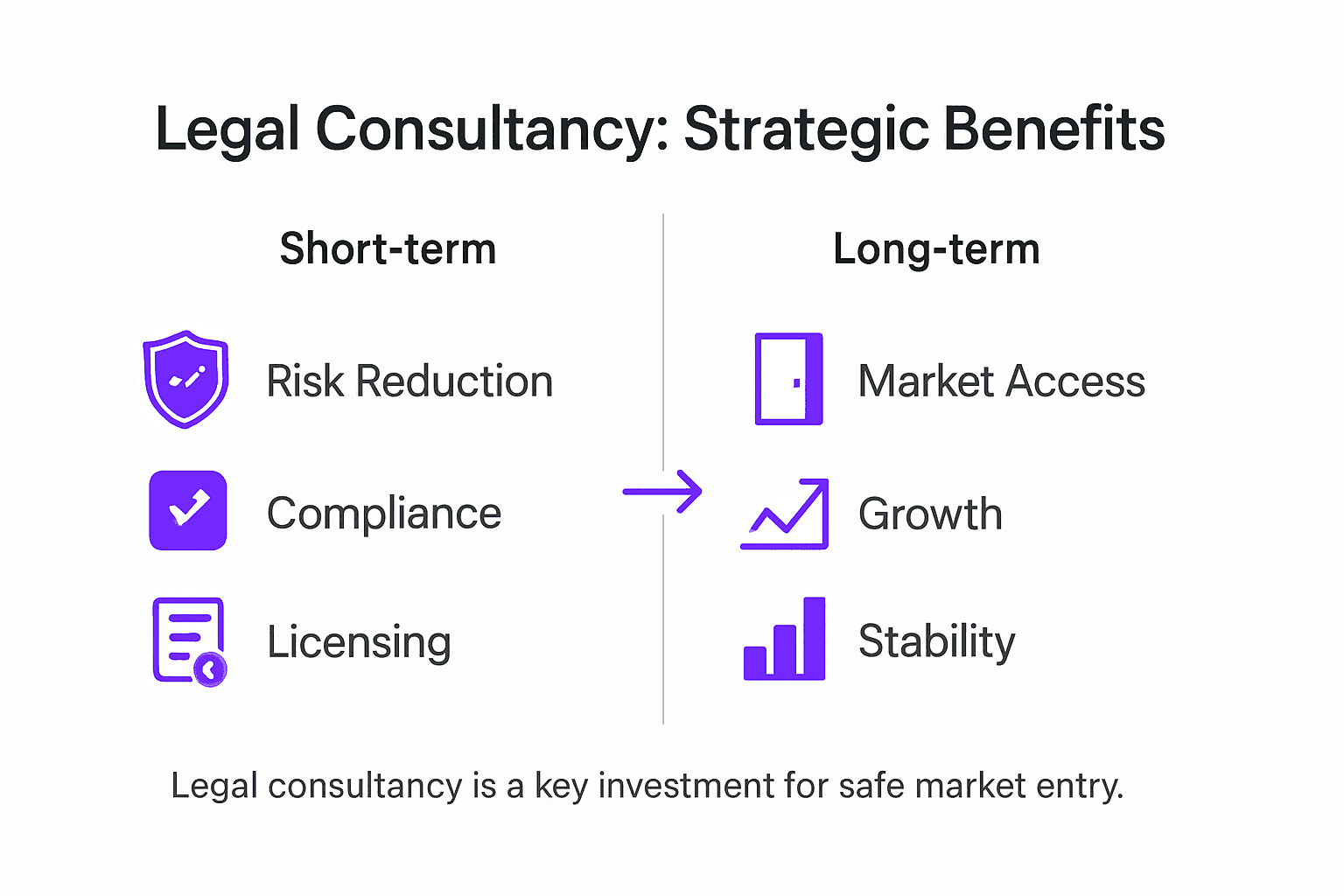
Cost considerations in legal consultancy involve a nuanced evaluation of both direct financial investments and potential risk mitigation benefits. While initial consulting fees might appear significant, they represent a strategic investment that can prevent exponentially more expensive legal complications. Typical cost structures include hourly rates, project-based pricing, retainer agreements, and specialised service packages tailored to specific organisational needs and risk profiles. The most sophisticated legal consultancies offer scalable solutions that align closely with a company’s financial constraints and strategic objectives.
Strategic benefits of comprehensive legal consultancy span multiple organisational dimensions, including regulatory resilience, intellectual property protection, dispute prevention, and enhanced market expansion capabilities. By embedding legal literacy into organisational strategy, consultants help businesses develop robust governance frameworks, anticipate potential regulatory shifts, and create adaptive compliance mechanisms. These approaches not only minimise legal vulnerabilities but also enable businesses to pursue innovative strategies with greater confidence and reduced operational risk.
The following table summarises direct and strategic impacts of legal consultancy investment:
Investment Aspect | Short-term Benefit | Long-term Advantage |
Licensing Support | Fast market entry | Lower ongoing compliance risk |
Compliance Programmes | Immediate risk reduction | Enhanced regulatory resilience |
IP Management | Protected innovation | Global brand value growth |
Governance Frameworks | Transparent operations | Stakeholder trust and loyalty |
Pro Investment Strategy Tip: Evaluate legal consultancy services not as an expense, but as a strategic investment with measurable risk reduction and potential competitive advantages across your entire organisational ecosystem.
Navigate High-Risk Markets with Trusted Legal Consultancy
Entering high-risk sectors like fintech, cryptocurrency, and gambling demands more than basic legal knowledge. Organisations face complex licensing hurdles, multi-jurisdictional compliance challenges, and evolving regulatory frameworks. These obstacles can create costly delays and jeopardise business legitimacy if not expertly managed. Understanding regulatory obligations and securing appropriate licences swiftly are critical steps to ensure safe market entry and sustainable growth.
At NUR Legal, we specialise in guiding startups and established businesses through these exact challenges. Our comprehensive suite of services includes obtaining crypto licences in Georgia and Seychelles and fast, affordable gaming licences such as Curaçao or Anjouan full gaming licensing. By leveraging strong relationships with regulators and offering transparent, efficient legal support, we help you convert complex compliance demands into strategic advantages.
Take control of your licensing and compliance journey today.
Discover how our expert legal consultancy can secure your place in regulated industries without the uncertainty. Visit our corporate and licensing services page and partner with a team that turns high-risk legal obstacles into clear, manageable pathways for market success.
Frequently Asked Questions
What is the role of legal consultancy in high-risk sectors?
Legal consultancy provides strategic advisory services to help organisations in high-risk sectors navigate complex regulatory environments. This includes guidance on compliance, risk management, and operational legitimacy.
How does legal consultancy assist with licensing in high-risk industries?
Legal consultancy supports the licensing process by preparing necessary documentation, conducting due diligence, and providing strategic guidance to meet jurisdiction-specific regulatory requirements.
Why is compliance monitoring important in high-risk sectors?
Compliance monitoring is crucial as it helps organisations stay aligned with evolving regulatory standards, reducing the risk of penalties and reputational damage associated with non-compliance.
What benefits can organisations expect from investing in legal consultancy?
Investing in legal consultancy can lead to enhanced regulatory resilience, better protection of intellectual property, dispute prevention, and streamlined market entry strategies, ultimately fostering sustainable growth.
Recommended


Comments