
Licensing Requirements 2025: Essential Shifts for Fintech and Crypto


Most british and American fintech founders will face tougher licensing challenges in 2025 as governments race to close regulatory loopholes in high-risk sectors. Over 100 jurisdictions have adopted stricter compliance frameworks, pushing startups to rethink how they manage Anti-Money Laundering, Know Your Customer, and risk oversight. Understanding these sweeping global changes is crucial for scaling operations and protecting your venture from costly regulatory missteps.
Table of Contents
Key Takeaways
Point | Details |
Regulatory Transformation | The financial technology sector is undergoing a significant overhaul in 2025, with new licensing requirements demanding greater compliance and operational transparency. |
Key Licence Types | High-risk sectors require specific licences, such as Payment Stablecoin Licences and Crypto Exchange Operational Licences, to ensure adherence to stringent standards. |
Enhanced Compliance Standards | Compliance protocols now involve complex KYC and AML procedures, necessitating advanced technological solutions and transparent reporting mechanisms. |
Strategic Opportunities | Firms that proactively adapt to the new regulatory landscape can leverage operational transparency to enter new markets and attract institutional investment. |
Defining Licensing Requirements for 2025
The financial technology landscape is experiencing unprecedented regulatory transformation in 2025, with governments worldwide implementing structured frameworks to manage crypto and fintech operations. Global crypto regulation trends indicate a significant shift towards comprehensive licensing models that balance innovation with robust financial oversight.
Key developments are emerging across multiple jurisdictions, with regulatory bodies establishing clearer pathways for legitimate crypto and fintech enterprises. The United States has introduced federal legislation like the GENIUS Act, which provides unified licensing approaches for stablecoins, replacing previous fragmented state-level regulations. European regulators are simultaneously advancing the Markets in Crypto-Assets (MiCA) framework, creating standardised compliance requirements that offer greater legal certainty for digital asset operators.
The licensing landscape in 2025 demands a multifaceted approach from fintech and crypto startups. Organisations must now demonstrate sophisticated Anti-Money Laundering (AML) protocols, robust Know Your Customer (KYC) procedures, and comprehensive risk management strategies. These requirements are not merely bureaucratic checkboxes but fundamental mechanisms to ensure financial system integrity and protect investor interests. Emerging markets are also developing nuanced regulatory frameworks, recognising the need to attract innovative businesses while maintaining stringent protective measures.
Pro Tip: Engage specialised legal counsel with international regulatory expertise to navigate the complex 2025 licensing environment and develop a comprehensive compliance strategy tailored to your specific operational jurisdictions.
Key Licence Types in High-Risk Sectors
The cryptocurrency and financial technology ecosystems are characterised by increasingly sophisticated regulatory environments that demand precise licensing strategies. High-risk crypto sectors now face complex regulatory frameworks targeting specific operational domains, with particular emphasis on stablecoin issuers, cryptocurrency exchanges, and decentralised finance platforms.
In 2025, key licence types for high-risk financial technology sectors have become markedly more nuanced and jurisdiction-specific. Payment Stablecoin Licences represent a critical category, particularly in the United States, where the GENIUS Act mandates stringent reserve requirements and transparency protocols. These licences demand comprehensive documentation demonstrating robust financial infrastructure, including detailed capital adequacy reports, comprehensive risk management frameworks, and transparent operational governance.

Traditional cryptocurrency exchanges now require multilayered licensing approaches that encompass multiple regulatory dimensions. These include Money Services Business (MSB) Registration, Crypto Exchange Operational Licences, and Digital Asset Custodian Certifications. Each licence type addresses specific operational risks, with regulators implementing increasingly granular assessment criteria that evaluate technological infrastructure, security protocols, and institutional financial stability. Emerging markets in Asia are particularly focused on developing granular licensing models that balance innovation potential with rigorous risk mitigation strategies.
Here’s a summary of major new licence types in high-risk financial technology sectors for 2025:
Licence Type | Main Jurisdiction | Distinctive Requirement | Business Impact |
Payment Stablecoin Licence | United States | Stringent reserve protocols | Enables legal stablecoin issuance |
Crypto Exchange Operational | Asia, Europe | Multi-tier security frameworks | Permits compliant trading activities |
Money Services Business (MSB) | North America | Broad registration process | Allows custody and asset transfers |
Digital Asset Custodian | European Union, Asia | Detailed capital adequacy review | Authorises secure asset management |
Pro Tip: Develop a comprehensive, jurisdiction-specific licensing roadmap that anticipates regulatory evolution and proactively addresses potential compliance challenges across multiple operational territories.
Major Jurisdictions and Regulatory Changes
Global cryptocurrency regulation has undergone remarkable transformation in 2025, with over 100 jurisdictions establishing comprehensive crypto-specific regulatory frameworks. The international landscape reveals a complex tapestry of approaches, each reflecting unique national economic priorities and technological perspectives while converging towards more structured oversight of digital financial ecosystems.
In North America, significant shifts are evident across different regulatory environments. The United States has implemented a new federal approach, characterised by transparent frameworks that aim to integrate cryptocurrencies within traditional financial systems. Stablecoin Regulation has become a particular focus, with new legislation introducing stringent requirements for reserve management and operational transparency. Canada has simultaneously emphasised Anti-Money Laundering (AML) compliance, mandating rigorous exchange registration processes that prioritise institutional integrity and consumer protection.
European and emerging market jurisdictions present equally nuanced regulatory strategies. The European Union’s Markets in Crypto-Assets (MiCA) regulation represents a landmark development, establishing unified crypto licensing standards across member states. In contrast, Latin American countries are adopting more adaptive approaches, with several nations exploring cryptocurrency integration as a potential mechanism for economic stabilisation amid ongoing financial challenges. Asian markets continue to demonstrate a delicate balance between innovation promotion and strict regulatory control, implementing granular licensing frameworks that evaluate technological infrastructure and institutional risk management capabilities.
The following table compares regulatory priorities in key global regions for fintech and crypto in 2025:
Region | Regulatory Focus | Compliance Priority | Innovation Approach |
United States | Stablecoin reserves | Unified licensing model | Integration with traditional finance |
Canada | AML protocols | Rigorous exchange oversight | Institutional integrity first |
European Union | MiCA standardisation | Pan-European licensing | Harmonised legal requirements |
Asia | Infrastructure review | Granular risk assessment | Balancing innovation and control |
Latin America | Economic stability | Adaptive legal frameworks | Crypto integration for growth |
Pro Tip: Develop a dynamic, jurisdiction-specific compliance strategy that anticipates regulatory evolution and can be rapidly adapted to emerging international frameworks.
Core Obligations and New Compliance Standards
The evolving regulatory landscape demands increasingly sophisticated compliance frameworks for fintech and cryptocurrency enterprises. Compliance requirements for startups now encompass a comprehensive range of Operational Risk Management protocols that extend far beyond traditional financial oversight mechanisms.
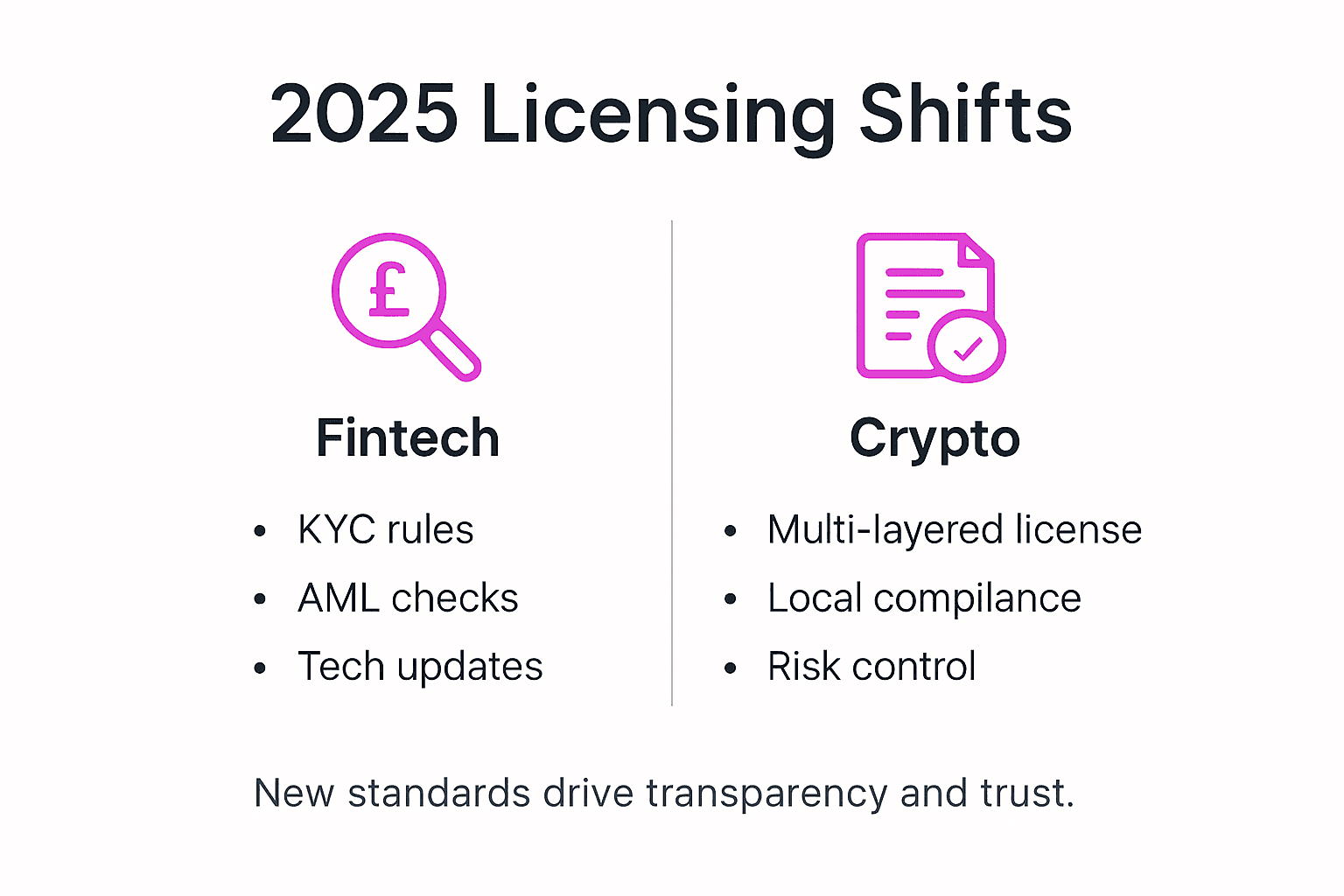
Modern compliance standards mandate multi-layered verification processes that integrate advanced technological solutions with rigorous human oversight. Know Your Customer (KYC) and Anti-Money Laundering (AML) protocols have become exponentially more complex, requiring real-time transaction monitoring, sophisticated algorithmic risk assessment, and granular customer verification mechanisms. Financial institutions must now demonstrate not just procedural compliance, but proactive risk mitigation strategies that can adapt to rapidly changing technological and regulatory environments.
The emerging compliance ecosystem places unprecedented emphasis on transparency, data protection, and institutional accountability. Organisations must develop robust internal control frameworks that can systematically document, track, and report complex financial transactions across multiple jurisdictions. This includes implementing advanced cybersecurity measures, maintaining comprehensive audit trails, and developing adaptive compliance management systems that can respond dynamically to regulatory shifts and emerging technological challenges.
Pro Tip: Invest in integrated compliance management platforms that offer real-time regulatory tracking, automated reporting capabilities, and flexible risk assessment tools to stay ahead of evolving regulatory requirements.
Risks, Mistakes, and Strategic Opportunities
Crypto regulatory developments in 2025 have transformed the financial technology landscape, revealing critical distinctions between organisations that strategically navigate regulatory frameworks and those that struggle with compliance complexities. The emerging regulatory environment presents a nuanced ecosystem where understanding potential risks and opportunities becomes paramount for sustainable business growth.
Common mistakes in this evolving landscape predominantly stem from misunderstanding multi-jurisdictional obligations and underestimating the depth of regulatory requirements. Compliance Risks now extend beyond traditional financial oversight, demanding sophisticated Operational Risk Management strategies that integrate advanced technological monitoring with comprehensive legal understanding. Financial institutions must develop adaptive frameworks capable of responding dynamically to regulatory shifts, with particular emphasis on Know Your Customer (KYC) and Anti-Money Laundering (AML) protocols.
Strategic opportunities emerge for organisations that proactively embrace regulatory clarity. Jurisdictions demonstrating balanced approaches between innovation protection and consumer safeguarding are creating environments where institutional adoption can flourish. This involves developing robust internal control mechanisms, maintaining comprehensive audit trails, and implementing cybersecurity measures that not only meet but anticipate regulatory expectations. Firms that successfully navigate these complex requirements can leverage operational transparency to expand into new markets, attract institutional investment, and establish credibility within the rapidly evolving digital financial ecosystem.
Pro Tip: Develop a comprehensive regulatory intelligence system that provides real-time insights into global compliance shifts, enabling your organisation to anticipate and adapt to emerging legal requirements.
Secure Your Fintech and Crypto Future with Expert Licensing Support
Navigating the complex licensing and compliance landscape in 2025 requires specialised legal expertise focused on Anti-Money Laundering (AML), Know Your Customer (KYC) protocols, and evolving multi-jurisdictional regulations. If you are a fintech startup or crypto enterprise striving to meet new regulatory demands such as the GENIUS Act or the European MiCA framework, failure to act swiftly risks costly delays and compliance issues. Trust in a partner who understands these challenges intimately and can help you secure licences like Payment Stablecoin, Crypto Exchange Operational, or Digital Asset Custodian swiftly and efficiently.
At NUR Legal, we specialise in guiding high-risk and regulated businesses through these exact hurdles. With trusted licensing services for crypto jurisdictions including Georgia and Seychelles, as well as comprehensive gaming licences from Curaçao and Anjouan, we offer tailored solutions to help you establish compliant and scalable operations globally. Start protecting your business from compliance pitfalls today and turn regulatory complexity into your strategic advantage with our professional legal consultancy. Discover more about our services at NUR Legal and begin your licensing journey with confidence.
Frequently Asked Questions
What are the major licensing requirements for fintech and crypto companies in 2025?
In 2025, fintech and crypto companies must demonstrate robust Anti-Money Laundering (AML) protocols, strong Know Your Customer (KYC) practices, and comprehensive risk management strategies to obtain necessary licences.
How have licensing frameworks evolved for cryptocurrency exchanges this year?
Licensing frameworks for cryptocurrency exchanges now require multilayered approaches, including Money Services Business (MSB) registration, Crypto Exchange Operational Licences, and Digital Asset Custodian Certifications, which focus on operational risks and compliance standards.
What role does the GENIUS Act play in regulatory changes for stablecoins?
The GENIUS Act provides a unified licensing approach for stablecoins, establishing stringent reserve requirements and transparency protocols, which replaces previous fragmented state-level regulations in the United States.
What should companies do to stay compliant with the new regulatory standards?
Companies should develop a comprehensive, jurisdiction-specific licensing roadmap, invest in integrated compliance management platforms, and maintain robust internal control frameworks to adapt to evolving regulatory environments.
Recommended


Comments