
Regulatory Due Diligence: Safeguarding High-Risk Ventures


Nearly one in four british crypto and online gambling startups fail their initial licensing attempt due to overlooked regulatory requirements. For compliance officers and founders working in high-risk sectors, the difference between success and costly setbacks often hinges on effective due diligence. This article highlights how systematic risk assessment, robust documentation, and an understanding of legal standards across multiple jurisdictions can protect your operations and reputation.
Table of Contents
Key Takeaways
Point | Details |
Regulatory Due Diligence | In high-risk sectors, regulatory due diligence is essential for identifying and mitigating compliance risks through proactive management strategies. |
Types of Processes | Key types of regulatory due diligence include value chain mapping, stakeholder engagement, and digital compliance, each focusing on distinct aspects of risk assessments. |
Documentation Strategies | Robust regulatory documentation, including compliance policies and due diligence checklists, is crucial for evidencing compliance efforts and systematic risk management. |
Risk Management | Companies must implement comprehensive risk assessment frameworks that integrate technology and expert oversight to address potential compliance vulnerabilities effectively. |
Defining Regulatory Due Diligence in High-Risk Sectors
Regulatory due diligence represents a systematic approach to identifying, assessing, and mitigating legal and compliance risks within high-stakes business environments. At its core, this process involves comprehensive investigation and evaluation of potential regulatory challenges that could impact an organisation’s operational integrity and financial stability.
In high-risk sectors such as cryptocurrency, online gambling, and international finance, regulatory due diligence goes beyond simple compliance checks. It requires proactive risk management strategies that anticipate potential regulatory shifts and preemptively address potential legal vulnerabilities. The EU Corporate Sustainability Due Diligence Directive exemplifies this approach, mandating companies identify, prevent, and mitigate adverse human rights and environmental impacts across global operations.
The fundamental objectives of regulatory due diligence include comprehensive risk assessment, legal framework alignment, and establishing robust governance mechanisms. This involves multiple critical components: thorough documentation review, regulatory landscape mapping, compliance gap analysis, and developing adaptive strategies that can respond quickly to evolving legal requirements. Multinational enterprises must now govern sustainability performance across entire supply chains, moving beyond traditional transparency models towards enforceable legal standards of care.
Professional Tip: Develop a dynamic compliance framework that treats regulatory due diligence as an ongoing process rather than a one-time checklist, integrating continuous monitoring and adaptive risk management strategies.
Types of Regulatory Due Diligence Processes
Regulatory due diligence encompasses a diverse range of systematic processes designed to identify, assess, and mitigate potential legal and compliance risks across different business environments. These processes are critically important for organisations operating in high-risk sectors, where regulatory landscapes can be complex and rapidly evolving.
The first primary type of regulatory due diligence involves value chain mapping, which requires organisations to comprehensively examine risk landscapes throughout their entire operational ecosystem. This approach demands meticulous investigation of each segment within the supply chain, identifying potential regulatory vulnerabilities, human rights risks, environmental impacts, and governance challenges. Companies must develop sophisticated mechanisms to trace and evaluate potential risks at every stage of their business operations.
Another crucial category of regulatory due diligence is stakeholder engagement due diligence. This process involves actively communicating with regulators, industry experts, legal professionals, and internal compliance teams to develop a nuanced understanding of emerging regulatory requirements. Under new European Union regulations like the Corporate Sustainability Due Diligence Directive, organisations are increasingly required to demonstrate proactive risk management through continuous stakeholder interaction and risk mitigation strategies.
The third significant type is digital compliance due diligence, which leverages advanced technological tools and data analytics to monitor, track, and assess regulatory compliance in real-time. This approach enables organisations to implement dynamic risk management frameworks that can quickly adapt to changing regulatory environments, particularly in fast-moving sectors like financial technology and international digital commerce.
Professional Tip: Implement a multidimensional due diligence strategy that combines technological monitoring, stakeholder engagement, and comprehensive value chain mapping to create a robust and adaptive regulatory compliance framework.
The following table contrasts the three main types of regulatory due diligence processes and highlights their unique focus areas and business benefits:
Due Diligence Type | Primary Focus | Business Benefit |
Value Chain Mapping | Detailed supply chain risk analysis | Minimises hidden operational risks |
Stakeholder Engagement | Continuous interaction with key parties | Strengthens compliance relationships |
Digital Compliance | Real-time data monitoring and analytics | Enhances speed and accuracy |
Key Steps and Documentation Requirements
Regulatory due diligence necessitates a comprehensive and structured approach to documentation that serves as the foundational evidence of an organisation’s compliance efforts. The process involves creating a robust paper trail that demonstrates systematic risk assessment, mitigation strategies, and adherence to legal standards across all operational domains.
The initial step in regulatory documentation involves developing comprehensive compliance policies. These policies must articulate the organisation’s commitment to regulatory adherence, outlining specific procedures for risk identification, assessment, and management. Key documentation should include detailed risk mapping reports, internal communication records, transaction monitoring logs, and explicit guidelines for handling potential compliance breaches. Organisations must maintain meticulous records that not only demonstrate current compliance but also showcase the proactive measures taken to prevent potential regulatory violations.
Another critical aspect of regulatory documentation is the creation of a comprehensive due diligence checklist. This instrument serves as a structured approach to systematically evaluate potential risks, business partners, transactions, and operational processes. Regulatory documentation must cover multiple dimensions, including supplier agreements, employee training records, historical regulatory compliance reports, and detailed transaction assessments. The checklist should be dynamic, allowing for continuous updates as regulatory landscapes evolve and new risks emerge.
The final crucial step involves establishing a robust document management system that ensures the integrity, accessibility, and security of all compliance-related documentation. This system should incorporate digital archiving, version control, and secure access protocols to protect sensitive information while maintaining transparency and auditability. Organisations must implement technological solutions that enable efficient retrieval, analysis, and reporting of regulatory documentation.
Professional Tip: Implement a digital document management system with automated version control and comprehensive audit trails to streamline regulatory documentation and ensure real-time compliance tracking.
The table below summarises key documentation requirements for effective regulatory due diligence, with their compliance and audit benefits:
Document Type | Compliance Advantage | Audit Benefit |
Risk Mapping Reports | Maps exposure to regulatory risk | Evidences assessment effort |
Supplier Agreements | Clarifies legal obligations | Demonstrates partner vetting |
Training Records | Shows staff competence | Proves ongoing education |
Transaction Assessments | Tracks suspicious activities | Supports investigation |
Legal Standards Across Multiple Jurisdictions
Navigating legal standards across multiple jurisdictions represents a complex challenge for organisations operating in high-risk and internationally diverse business environments. The regulatory landscape requires sophisticated understanding and strategic compliance approaches that can adapt to varying legal frameworks and emerging international standards.

The European Union has been at the forefront of developing harmonised regulatory frameworks that seek to create consistent legal standards across member states. This approach is particularly evident in sectors such as anti-money laundering, where the EU Anti-Money Laundering Package establishes centralized supervision through the Authority for Anti-Money Laundering and Countering the Financing of Terrorism (AMLA). Such initiatives demonstrate a critical trend towards standardisation, enabling organisations to develop more predictable compliance strategies across different national contexts.
Multinational corporations must develop nuanced strategies that account for complex corporate governance requirements. These strategies involve understanding subtle differences in reporting standards, directors’ duties, and regulatory expectations across various jurisdictions. The challenge lies not just in compliance, but in creating flexible governance models that can seamlessly adapt to diverse legal environments while maintaining core operational integrity.
Key considerations for managing legal standards across multiple jurisdictions include developing comprehensive compliance protocols, maintaining detailed documentation of regulatory variations, and implementing robust risk assessment mechanisms that can quickly identify and respond to changing legal requirements. Organisations must invest in continuous legal education, technological compliance tools, and strategic advisory resources to effectively navigate this complex regulatory landscape.
Professional Tip: Develop a centralised compliance intelligence system that tracks regulatory changes across different jurisdictions in real-time, enabling proactive adaptation to emerging legal requirements.
Risks, Red Flags, and Common Oversights
Regulatory due diligence demands a meticulous approach to identifying potential risks and preventing critical compliance vulnerabilities across high-risk business operations. Understanding these risks requires a comprehensive perspective that goes beyond superficial assessments and delves into the nuanced landscape of regulatory challenges.
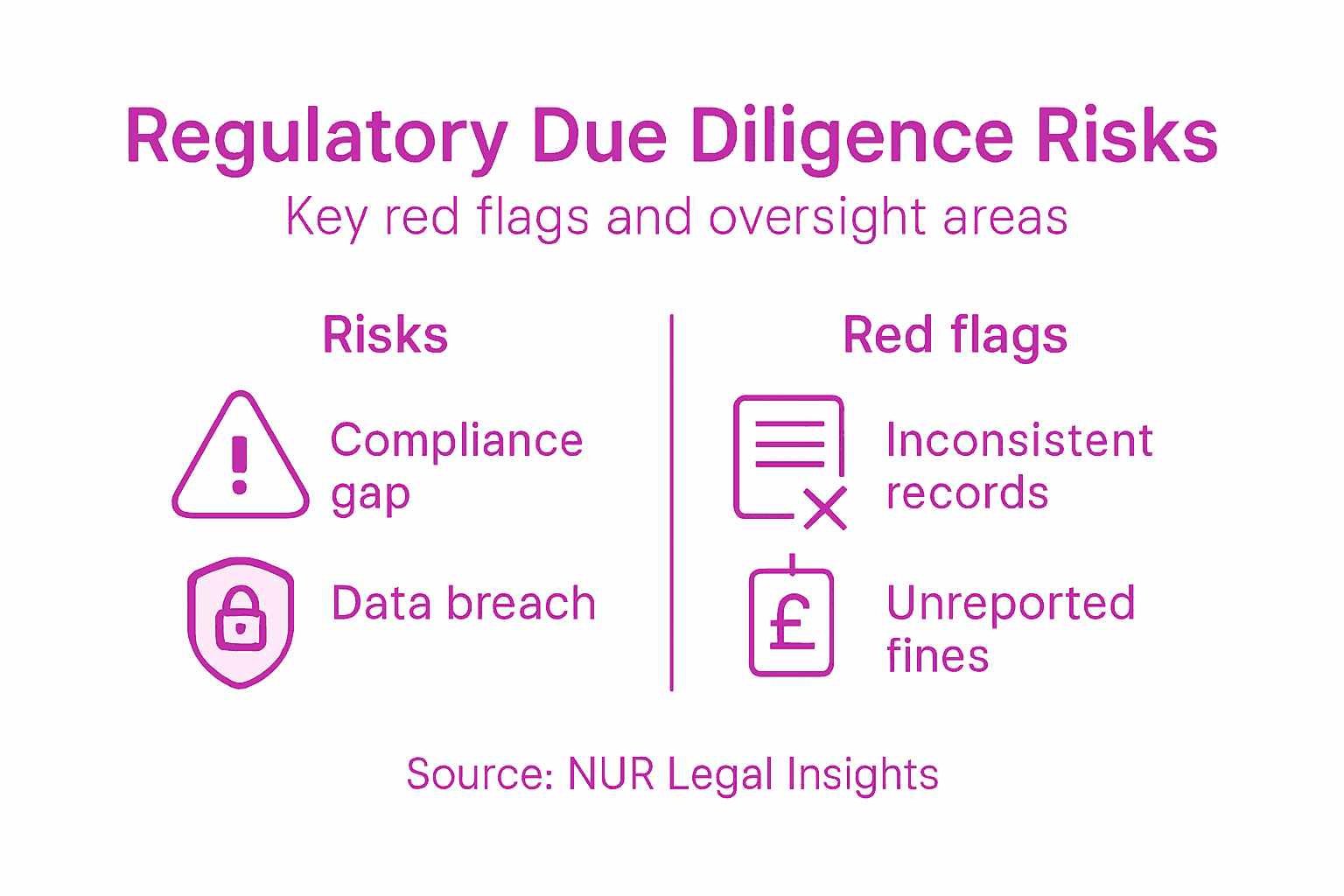
Organisations must be vigilant in recognising complex compliance red flags. These warning signs often manifest through subtle indicators such as incomplete documentation, opaque transaction histories, and inconsistent regulatory reporting. Common risks include circumvention tactics, inadequate risk assessments, and insufficient monitoring of business partners and transactions. Particularly in export-related sectors and complex supply chains, transparency becomes a critical challenge that demands sophisticated investigative techniques.
The most prevalent oversights in regulatory due diligence typically stem from systemic gaps in organisational processes. Comprehensive regulatory risk assessments reveal that organisations frequently neglect critical areas such as thorough reviews of regulatory histories, comprehensive supplier compliance evaluations, and robust employee training programmes. These oversights can create significant legal and financial vulnerabilities, potentially exposing businesses to substantial regulatory penalties and reputational damage.
Effective risk management requires a multifaceted approach that combines technological solutions, expert human intelligence, and rigorous procedural frameworks. Organisations must develop dynamic risk assessment models that can quickly identify and respond to emerging regulatory challenges, integrating advanced monitoring technologies with deep regulatory expertise.
Professional Tip: Implement a comprehensive risk assessment framework that combines automated compliance monitoring tools with regular expert audits to create a proactive and adaptive regulatory defence strategy.
Secure Your High-Risk Ventures with Expert Regulatory Support
Navigating the complexities of regulatory due diligence in sectors like crypto, gambling, and fintech requires more than basic compliance checks. You need a proactive approach that anticipates evolving legal requirements and mitigates risks across multiple jurisdictions. From value chain mapping to digital compliance, the challenges can be overwhelming. Plus, managing detailed documentation and responding to regulatory red flags demands expert guidance to avoid costly oversights.
At NUR Legal, we specialise in providing tailored legal consultancy services that address these specific demands. Whether you require assistance in obtaining reliable gaming licenses such as Curaçao or Anjouan, or seek crypto licensing solutions in Georgia and Seychelles, our team is dedicated to building legally compliant operations for your unique high-risk venture. Take the stress out of regulatory due diligence and ensure your business thrives with expert support. Visit NUR Legal now to start your journey towards seamless and trustworthy compliance.
Frequently Asked Questions
What is regulatory due diligence?
Regulatory due diligence is a systematic process of identifying, assessing, and mitigating legal and compliance risks within high-risk business environments. It involves thorough investigations to navigate complex regulatory challenges that could affect an organisation’s integrity and stability.
Why is regulatory due diligence critical in high-risk sectors?
In high-risk sectors like cryptocurrency or online gambling, regulatory due diligence is essential due to the rapidly changing regulatory landscapes. It allows organisations to anticipate regulatory shifts, manage risks proactively, and ensure compliance with evolving legal requirements.
What are the main types of regulatory due diligence processes?
The main types of regulatory due diligence processes include value chain mapping, which analyses risks throughout the operational ecosystem; stakeholder engagement due diligence, which focuses on communication with key parties; and digital compliance due diligence, which uses advanced technology for real-time monitoring.
What key documentation is required for effective regulatory due diligence?
Effective regulatory due diligence requires documentation such as risk mapping reports, supplier agreements, employee training records, and transaction assessments. These documents help demonstrate compliance efforts and the strategies implemented to manage legal risks.
Recommended


Comments